
Contractors who document and share their installation process win more jobs, reduce callbacks, and build stronger referral networks than those who only show completed projects. A finished roof is a good photo, but it reveals little about the work underneath. In New Mexico, where UV exposure, temperature swings, hail, and wind stress roofing systems, the hidden layers matter more than the surface.
How to attract qualified homeowners for roofing jobs in New Mexico.
Finished photos sell the result, but homeowners are buying the process
Most homeowners cannot evaluate roofing quality by looking at a shingled roof. Two installations can look identical from the street while one has a proper ice and water barrier at the eaves and valleys and the other has bare deck and a few nails. When you show only the finished product, you ask the customer to take your word for it. When you show the process, you give them evidence.
This matters most when you are competing on price. A homeowner comparing three bids will often choose the lowest one unless something visibly separates the contractors. A documented process gives your bid a reason to cost more. It shows the underlayment brand, the drip edge, the ventilation plan, and the deck repairs that a cheaper competitor may skip.
New Mexico’s conditions reward transparent work
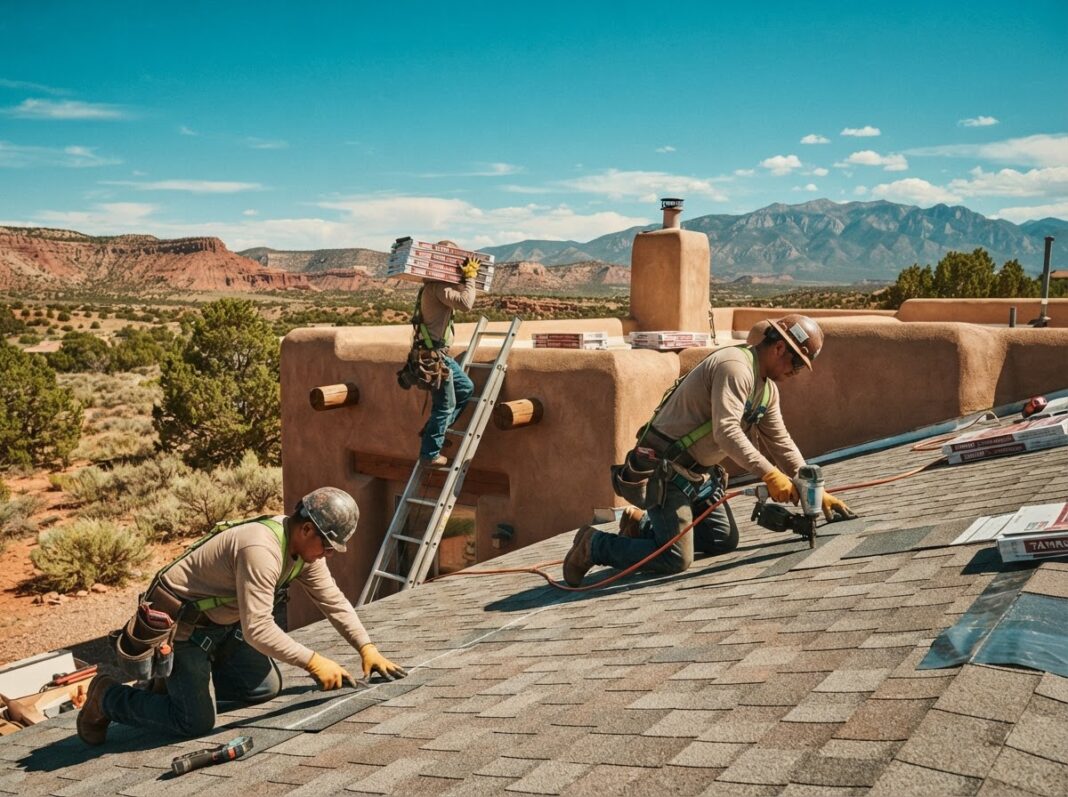
Roofing in New Mexico punishes shortcuts. High-altitude UV degrades asphalt and sealants faster than many homeowners expect. Daily temperature swings cause expansion and contraction that loosen fasteners and crack flashing sealant over time. Spring and summer hail can reveal whether shingles were nailed to the manufacturer’s pattern, and monsoon winds test whether starter strips, sealed edges, and nailing were done correctly. Heavy snow in the northern mountains adds load and ice-dam risk.
Documentation helps you show that you understood these conditions and planned for them. A photo log that shows you checking deck integrity, installing a self-adhering membrane at vulnerable spots, or balancing intake and exhaust ventilation tells a homeowner that you are thinking about their specific climate, not following a generic template.
Documentation protects you when problems arise
Callbacks and disputes are expensive, and many start with a simple question: “Did you put the underlayment down correctly?” Without records, the answer depends on memory and the homeowner’s willingness to believe you. With dated photos, the answer is on your phone.
Process documentation helps in three situations:
- Warranty claims: Manufacturers often require proof that the system was installed according to their specifications. Your photos of the underlayment, nailing, and flashing can be the difference between a covered claim and a denied one.
- Insurance claims: When a storm damages a roof and an adjuster questions the condition of the deck or the age of the work, your records show what was there before the loss.
- Warranty disputes with your own crew: Photos also show which crew members followed the standard and which did not, which makes coaching specific.
Build a documentation habit that does not slow the crew
Contractors often avoid documentation because they assume it adds time. In practice, a short routine adds only a few minutes per job if it is built into the workflow.
Set a minimum photo standard
Create a checklist for each stage of the job: tear-off, deck inspection, deck repairs, underlayment, ice barrier, drip edge, shingle courses, valleys, flashing at penetrations and walls, ridge and vent installation, and final cleanup. Require at least one wide shot and one close-up for each stage. Close-ups should show nail placement and lapping. Wide shots should show alignment and overall progress.
Use one shared system
Assign a standard naming convention, such as address, date, and stage, and store everything in a shared folder or job management app. Photos scattered across employee phones are nearly useless when you need them six months later.
Record the materials
Photograph material labels or packaging when you open them, especially underlayment, membranes, and fasteners. Specific product names carry weight with homeowners and warranty administrators.
Turn the best content into marketing
Short video clips of a crew explaining why they lined a valley with membrane, or why they replaced a section of rotted OSB, make compelling social posts. Before-and-after deck galleries are especially persuasive because they show problems most homeowners never knew existed.
Give the homeowner a copy
Send each customer a dated photo report at project completion, either as a PDF or a link to a shared folder. This turns your documentation into part of their home records. It also makes your name the one they remember when a neighbor asks who did their roof. A homeowner who can show their insurance company or a future buyer exactly what was installed is a homeowner who will recommend you.
The bottom line
Showing the installation process is not a gimmick. It is an honest way to demonstrate expertise in a market where most of your best work will never be visible once the job is finished. In New Mexico’s demanding climate, that transparency helps you win bids, defend your work, and build a reputation that outlasts any single roof.
How to attract qualified homeowners for roofing jobs in New Mexico.