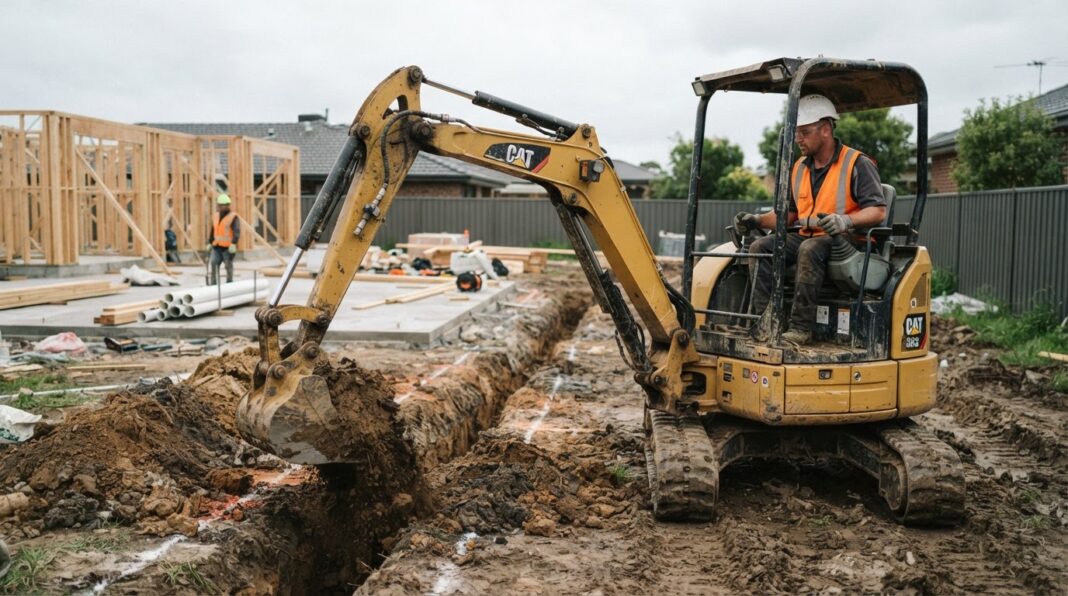

A completed excavation project gives you more than another job to invoice. It gives you real examples of your services, photos of the site transformation, and a story about the work your crew performed. Excavation marketing guidance recommends using project galleries, before-and-after images, and short case studies to help prospective customers understand a contractor’s capabilities.
The opportunity is to turn completed work into proof—not just tell people what your company does, but show them relevant examples.
Show the Change Your Crew Delivered
A finished excavation site may not tell the whole story on its own. Pairing the result with photos of the original conditions helps explain what changed and what your team accomplished.
Before-and-after comparisons can illustrate land clearing, foundation excavation, grading, and other site transformations. Excavation marketing guidance specifically recommends these examples, while construction-content guidance advises capturing matching viewpoints so the comparison focuses on the work rather than differences in photography.
Add a short description explaining:
- What the customer needed.
- Which services your team performed.
- What site conditions affected the work.
- What was completed and what came next.
That context turns a picture of dirt and equipment into an understandable project story.
Explain the Work Behind the Result
Photos attract attention, but a project summary can show how your company approached the job.
For example, a relevant case study might describe limited site access, challenging ground conditions, or a particular scheduling requirement. Excavation marketing guidance recommends explaining site constraints and including verified details such as project size, quantities moved, or completion time where available.
Only include claims you can support. A photo cannot establish compaction results, grade accuracy, or compliance on its own. Use documented project information when describing technical outcomes, and keep the explanation clear enough for your intended customer to understand.
A useful project story follows a straightforward structure: the customer’s need, the scope of work, the challenge, your approach, and the result. Construction case-study guidance recommends this format to help potential clients connect a contractor’s experience with their own requirements.
Help Prospective Customers Find Relevant Experience
Different customers may be looking for different capabilities. Someone planning a residential build may want to see foundation excavation examples, while another prospect may be interested in clearing or site preparation.
An organized portfolio lets visitors find projects that resemble the work they need. Excavation marketing guidance recommends pairing service and location information with local project galleries and case studies.
Rather than placing every photo in one general gallery, consider grouping projects by the services your company actually offers. Each example can then help answer a practical question: “Has this contractor handled work like mine?”
Turn One Project Into Several Useful Pieces of Content
You don’t need a new job for every new post. One well-documented project can provide material for several formats:
- A before-and-after social post.
- A short progress video.
- A website project summary.
- An explanation of a site challenge.
- A customer testimonial, shared with permission.
- An example to include in a proposal or follow-up email.
Construction marketing guidance recommends repurposing case studies into social content, short videos, and email campaigns. Excavation guidance also highlights equipment footage and time-lapse videos as ways to show work in progress.
Give each piece a distinct purpose. The photo comparison shows the transformation; the project summary explains the scope; the video shows the process.
Make Documentation Part of the Job
The strongest completed-project content usually starts before the project is finished. Without “before” photos or progress images, you may lose the chance to explain how the site changed.
Construction photography guidance recommends capturing original project images and passing them, along with a job summary, to whoever manages your marketing. Consistent angles, clear images, and descriptive captions make the material easier to use.
A practical internal checklist could be:
- Confirm authorization to photograph and publish the work.
- Capture the site before work begins.
- Photograph relevant stages without interrupting operations.
- Take finished photos from comparable viewpoints.
- Record the service, general location, scope, and verified outcomes.
- Store the approved images and summary together.
Not every job needs a lengthy case study. Some deserve a brief photo update; others have enough complexity to support a detailed project page.
Give the Content a Clear Business Purpose
Your project content should help someone understand whether your company is a fit—not merely fill your social media calendar. Construction case-study guidance recommends answering common sales questions and explaining the challenges and solutions behind the work.
Connect each project to the relevant service on your website and give interested visitors a straightforward way to ask about similar work. A completed job then becomes a useful reference for both marketing and sales conversations.
Every project is an opportunity to capture something valuable, even if not every project should be published. The aim is to build a credible collection of real work that helps future customers understand your experience before they contact you.