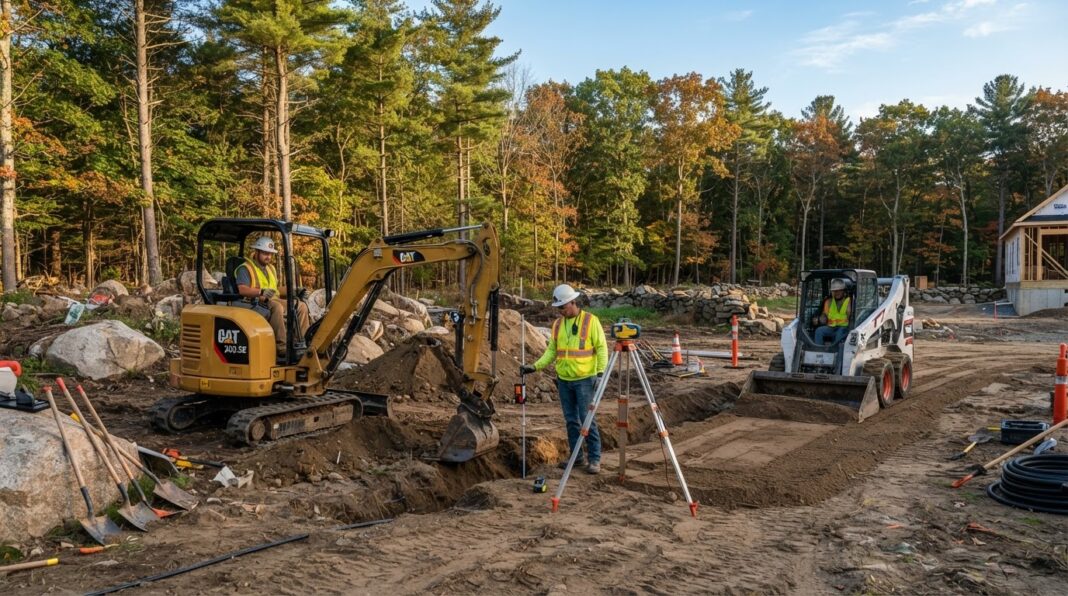

In New Hampshire and similar climates, a “finished photo” of a grading and drainage project is often misleading because the most critical components of the work are invisible once the surface is restored. A photo of a green lawn or a smooth driveway shows the aesthetic result, but it does not prove that the engineering required to protect a foundation is actually in place.
How to attract qualified homeowners for excavation jobs in New Hampshire.
Grading and drainage projects require comprehensive documentation beyond the final image for several key reasons:
Invisible Infrastructure Much of the actual “work” in these projects happens underground. A finished photo cannot show if a French drain was installed with the correct perforated pipe, if it was wrapped in the proper filter fabric to prevent clogging, or if it was set in a sufficient bed of gravel. Similarly, a photo cannot verify the depth or slope of a subsurface pipe, which is the only way to ensure water is actually moving away from the structure rather than pooling underground.
The “Invisible” Slope Correct drainage relies on precise slopes—often as slight as 0.5 to 2 percent—to move water. To the naked eye (and the camera lens), a yard can look perfectly flat or “finished” while actually having a negative grade that directs water toward a basement. Documentation such as laser level readings, a stamped grading plan, or “during” photos of the slope verification process provides the only real proof that the ground is pitched correctly.
Soil Stability and Compaction A finished surface can hide unstable soil. If fill dirt is simply piled on and seeded without proper mechanical compaction, the ground will settle over time, creating new dips and “birdbaths” where water collects. Documentation of the compaction process (such as the equipment used or the number of lifts) is necessary to guarantee that the project won’t fail after the first few freeze-thaw cycles—a critical concern in New Hampshire’s harsh winters.
Accountability and Liability Because these projects are designed to prevent catastrophic structural damage (like foundation cracks or basement flooding), homeowners need a “paper trail” for insurance and future home sales. A finished photo is not a warranty. A complete project record—including the original site assessment, the design plan, and photos of the open trenches—serves as a technical record that the contractor followed professional standards.
How to attract qualified homeowners for excavation jobs in New Hampshire.